

TL;DR:
- Roses symbolize love through a deep cultural code built from mythology, religion, and Victorian social rituals.
- Understanding this system enhances gift-giving by enabling deliberate, meaningful, and emotionally nuanced choices.
Few flowers carry as much emotional weight as the rose. The question of why roses symbolise love has fascinated historians, botanists, and romantics for centuries, and the answer is far richer than “they are beautiful.” Roses are a cultural code, built from mythology, religious imagery, and Victorian social ritual, refined over thousands of years into the most recognisable symbol of romantic feeling in the world. Understanding how that code works makes you a sharply better gift-giver.
Table of Contents
- The historical roots of rose symbolism as love
- How Victorian floriography shaped the rose’s message of love
- The rose as a cultural shorthand for love today
- Decoding rose colours and their romantic meanings
- How to use rose symbolism to choose the perfect romantic gift
- Why seeing rose symbolism as a cultural system transforms your gifting
- Explore luxury rose gifts at OnlyRoses
- Frequently asked questions
Key Takeaways
| Point | Details |
|---|---|
| Historical layers | Rose symbolism grew from sacred, mythological, and cultural associations over centuries. |
| Victorian code | Floriography turned roses into a secret language of love expressed through flowers. |
| Colour meanings | Different rose colours communicate distinct romantic messages for meaningful gifting. |
| Modern signalling | Roses remain a versatile and elegant way to convey love with low verbal risk. |
| Smart gifting | Understanding rose symbolism helps select gifts that deeply resonate emotionally. |
The historical roots of rose symbolism as love
Roses did not become symbols of love overnight. Their meaning accumulated across civilisations, each one adding a new layer to what a rose could say without words.
The earliest associations are religious and mythological. In ancient Greece, the rose was sacred to Aphrodite, the goddess of love, and red roses trace back to Eros, the god of love, whose name was said to have been woven into the flower’s own. Early Christian iconography adopted the rose as a symbol of the Virgin Mary, linking it to purity, divine grace, and elevated love. These sacred associations gave the rose a seriousness that other flowers never acquired.
Rose symbolism as love grew from sacred and devotional associations, making it the most dominant flower used across cultures for love-related meanings. This happened because the rose was not just beautiful. It was ritually significant. That distinction matters enormously.
Key forces that shaped rose symbolism over history:
- Ancient Greek mythology connected roses directly to the gods of love and desire
- Early Christian iconography elevated the rose to a symbol of sacred, purified love
- Persian and Arabic poetry from the medieval period used the rose as the defining emblem of longing and devotion
- Renaissance painters placed roses in scenes of courtship and divine love to signal emotional content to viewers
- Victorian floriography formalised these accumulated meanings into a working social vocabulary
Each of these traditions reinforced the others, so by the time roses reached the modern era, their association with love was not merely decorative. It was deeply encoded.
How Victorian floriography shaped the rose’s message of love
By the 19th century, the rose’s symbolic weight was well established. What the Victorians did was give it grammar. In the 19th century, floriography transformed flower symbolism into a working coded language, where specific blooms and arrangements conveyed precise emotions that social convention made impossible to say aloud.
Victorian society placed enormous restrictions on direct emotional expression, particularly between unmarried individuals. Flowers filled the gap. A bouquet was not decoration. It was a letter.
How floriography worked in practice:
- Flower dictionaries were published and widely circulated, giving both sender and recipient the same reference point for interpretation
- The red rose was established as the clearest signal of passionate, romantic love, separate from the softer meanings of pink or white varieties
- The way a bouquet was handed over carried meaning: flowers tilted to the right meant a statement about the sender; tilted to the left, about the recipient
- Combining roses with other flowers created compound messages, allowing considerable emotional nuance within a single arrangement
- Ribbon colours, wrapping, and even the thorns left on or removed all modified the core message
Pro Tip: When gifting roses today, the rose colour meanings still follow Victorian conventions closely. Choosing your colour deliberately is not sentimental overthinking. It is simply communicating well.
The rose as a cultural shorthand for love today
Victorian floriography faded as a formal system, but the meanings it consolidated have proved extraordinarily durable. Today, roses are what semioticians would call a cultural shorthand: a symbol whose meaning is so widely shared that it communicates instantly, across languages and borders.
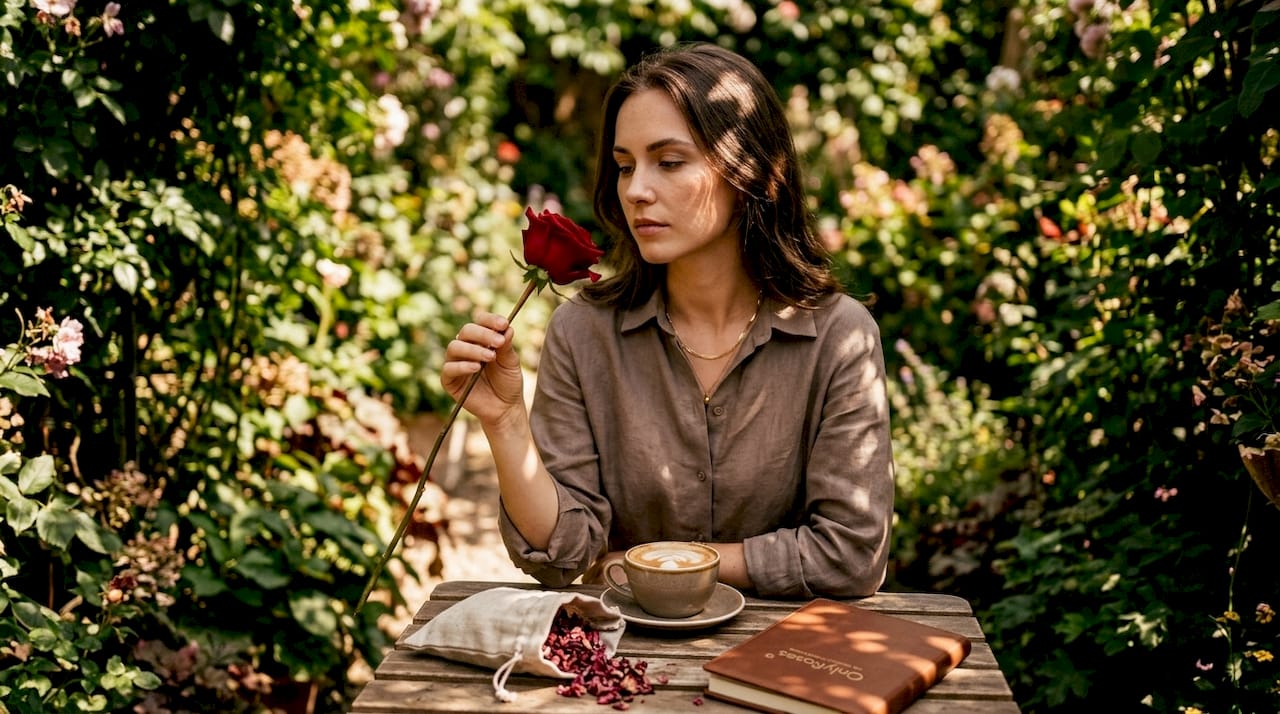
What makes this particularly useful for gift-givers is that roses carry emotional meaning with what researchers describe as low verbal risk. Even today, the rose works as a luxury gift offering a universally recognised emotional signal without requiring the giver to articulate feelings that might feel vulnerable or premature in words. A dozen red roses says something specific and serious without demanding a speech.
The sensory dimensions of the rose reinforce this. Flowers symbolise emotion because they arrive suddenly, fill the senses, and remind us that moments are precious. A rose engages sight, scent, and touch simultaneously. That multi-sensory impact makes the emotional message land harder than almost any other object.
“The rose’s beauty is inseparable from its brevity. That is precisely why it has always spoken about love, which is also beautiful and also impermanent.”
Why the rose continues to dominate romantic gifting today:
- Universal recognition means no decoding effort is required from the recipient
- The range of colours allows meaningful personalisation within a recognised framework
- The flower’s aesthetic refinement signals care and consideration on the part of the giver
- Roses in luxury gifting contexts signal status and intention simultaneously
Decoding rose colours and their romantic meanings
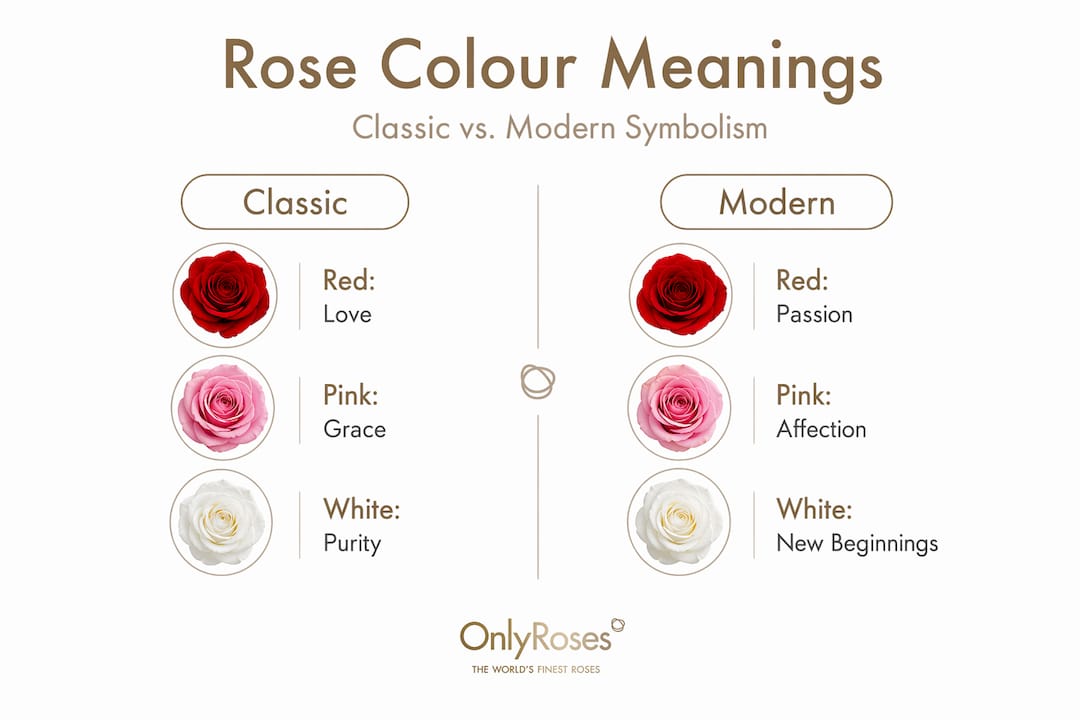
The question “are roses a sign of love?” has a more precise answer than most people expect. All roses carry emotional weight, but the colour determines exactly what kind of feeling is being expressed. Red roses symbolise passion and romance, whilst pink roses represent femininity and elegance, and white, orange, and yellow varieties each carry their own distinct sentiments.
| Colour | Primary meaning | Best used for |
|---|---|---|
| Red | Passion, desire, deep romance | Declarations of love, anniversaries |
| Pink | Tenderness, elegance, admiration | Early romance, appreciation, celebrations |
| White | Purity, innocence, new beginnings | First gifts, young love, heartfelt sincerity |
| Orange | Excitement, admiration, energy | New relationships, bold romantic gestures |
| Yellow | Joy, warmth, friendship | Celebrating a partner, lighthearted affection |
A few points worth knowing before you choose:
- A single red rose traditionally signals “I love you” as a complete, unambiguous statement
- Pale or blush pink sits closer to admiration; deeper pink reads as gratitude and appreciation
- White roses in combination with red carry a meaning of unity, making them well suited to weddings and significant anniversaries
- Orange roses are underused and genuinely striking, particularly for recipients who respond to energy and originality rather than tradition
Pro Tip: Browse the rose colour guide before choosing your arrangement. Selecting by colour rather than convenience is one of the simplest ways to make a gift feel considered rather than automatic.
How to use rose symbolism to choose the perfect romantic gift
The rose’s meaning is a system of colour, type, quantity, and social context, which means there are more expressive options available to you than most people realise. Choosing roses well is less about following rules and more about thinking deliberately.
A practical approach:
- Start with the relationship stage. Early romance calls for pink or orange. An established partnership can carry the full weight of red. Friendship-based affection suits yellow or peach.
- Consider the recipient’s personality. A person who responds to classic elegance will be moved by a dozen long-stemmed red roses. Someone who values originality might be better reached by an unusual colour or a sculptural arrangement.
- Think about quantity. Florists and gift-givers still use rose quantity as a signal: a single stem is intimate and direct; twelve signals generosity and commitment; twenty-four is unambiguous extravagance.
- Layer the presentation. The packaging communicates as much as the flower. A rose in premium presentation signals that the gift was considered, not grabbed.
- Consider preserved roses for lasting impact. Unlike fresh roses, preserved varieties maintain their beauty for months, turning a romantic gesture into a lasting object.
Key considerations for choosing rose bouquet meanings that land well:
- Cultural background can shift colour interpretation, so it is worth considering the recipient’s own associations
- Mixing colours within one arrangement creates a more complex, personal message than a single colour alone
- The occasion matters as much as the flower: the same red rose reads differently at Valentine’s, on a first date, or at a memorial
For detailed guidance on selecting roses for gifts, colour pairing, and occasion-matching, the considerations above give you a strong starting framework.
Why seeing rose symbolism as a cultural system transforms your gifting
Most people think of rose symbolism as a single fixed idea: red roses mean love, full stop. That framing undersells what roses can actually do for you as a gift-giver.
Love symbolism in roses is a system involving colour, type, quantity, and social context. When you understand it that way, you stop choosing roses because “that’s what you do” and start choosing them because you have something specific to say. That shift changes the entire experience for the recipient. A gift that clearly communicates a particular feeling is more powerful than a beautiful object with no discernible intention behind it.
There is also something worth noting about roses and romantic love as a form of safe communication. Gifting roses allows you to express a feeling at a level of intensity that words might make awkward. It is not evasion. It is calibration. The rose has served this purpose for thousands of years precisely because human emotional life requires it.
The rose symbolism insights built up across mythology, religion, and Victorian social code did not produce a single meaning. They produced a vocabulary. The red roses meaning is the most well-known word in that vocabulary, but it is far from the only one. Gift-givers who understand the full range communicate more clearly, more personally, and far more memorably.
Explore luxury rose gifts at OnlyRoses
Understanding the depth behind rose symbolism makes the quality of the rose itself matter far more. A flower that carries this much meaning deserves a presentation equal to what it is saying.

OnlyRoses sources exclusively from Ecuador’s high-altitude farms, where the combination of climate and elevation produces blooms with exceptional colour depth, long stems, and a bloom size that is simply not achievable at lower altitudes. Each arrangement arrives in signature hat-box packaging, designed to honour the flower rather than distract from it. For gifts intended to last beyond a single occasion, learn what preserved roses can offer in terms of longevity and sustained beauty. Or explore classic rose stems for timeless, elegant arrangements that carry the full weight of the symbolism you now understand. Use the rose colour guide to select the exact shade that matches the feeling you want to convey.
Frequently asked questions
Why did roses become the symbol of love?
The rose’s love symbolism evolved from sacred and mythological associations accumulated across ancient Greece, early Christianity, and medieval poetry, later consolidated by Victorian floriography into a widely understood language of romantic feeling.
What do different rose colours mean in romantic gifting?
Different rose colours carry distinct meanings: red for passion, pink for tenderness and elegance, white for purity and new beginnings, orange for admiration and excitement, and yellow for friendship and joy.
How does floriography influence modern rose gifting?
Victorian floriography established roses as a coded emotional language that allowed feelings to be communicated safely and subtly, a convention that continues to shape modern floral marketing and romantic gifting rituals today.
Can roses convey messages beyond romantic love?
Yes. Different rose colours express friendship, admiration, respect, and purity depending on context, making roses versatile gifts well beyond declarations of romantic love.

